
Home / Engineering Services / Piping design
Piping design and engineering
Layouts a fabricator can build from without a rewrite — routed with operability, supportability and thermal movement considered from the first pass.
Piping design sits alongside our structural and analysis disciplines in the same office, so a clash or a stress concern is resolved in a corridor conversation rather than a three-week email chain.
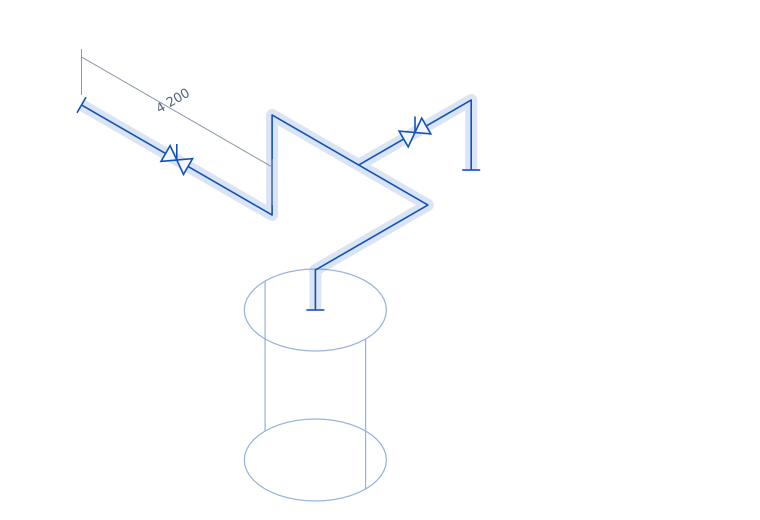
Routing is a design decision, not a drafting task
A pipe route that is geometrically valid can still be wrong. It can make a valve unreachable, put a flange where a crane cannot lift the equipment out, force a support onto a beam that was never designed for it, or lock in a thermal growth problem that only shows up at operating temperature.
Good routing weighs all of that at the same time. It is also where most downstream cost is set: material take-off, support count, fabrication hours and site rework all follow from decisions made in the first routing pass.
We design routes to be maintainable, supportable and buildable — and we flag the trade-offs where they exist rather than silently choosing for you.
Scope of work
Layout and routing
Plot plan development, equipment arrangement, pipe routing and rack loading, with operability and maintenance access as design inputs rather than afterthoughts.
Isometrics and fabrication drawings
Issue-ready isometrics with annotation, weld and spool detail, and bills of material extracted from the model rather than hand-counted.
Support design and scheduling
Support type selection, location and load determination, with loads passed to the structural discipline in a form they can use directly.
Material take-off and bills of material
Model-derived MTO for procurement, with the accuracy that comes from counting a model rather than estimating from a 2D drawing.
Coordination
Piping is the discipline most likely to be blamed for a clash and least likely to have caused it alone. Clashes are an interface problem between piping, equipment, structure and instrumentation.
We coordinate against the structural model and the equipment vendor data as the layout develops, rather than producing a route and discovering the conflicts at model review. Where vendor data is outstanding, we say which assumptions the layout depends on so the risk is visible.
Send the P&ID and the plot plan.
That is usually enough for us to scope a piping package and tell you what is missing.