
Home / Engineering Services / Finite element analysis
Finite element analysis
We work out how a component behaves under load before it is built — and report it in a form a certifying authority will accept.
Every FEA package is reviewed by a Chartered Engineer and NAFEMS PSE Assessor before issue. Our technical leadership
What we analyse
Most enquiries fall into one of three shapes. Something has failed and nobody knows why. Something must be certified and the calculation pack has to survive third-party review. Or something is being designed and the wall thickness, rib layout or nozzle reinforcement is still an open question.
All three are FEA problems, but they need different treatment. A failure investigation starts from the evidence and works backward. A certification package starts from the code and works forward. A design study runs comparisons. We scope the work to the question you are actually asking rather than running a standard model and sending the contour plots.
Analysis types
| Analysis | What it answers |
|---|---|
| Linear static | Does it survive the design load with the required margin? |
| Non-linear | What happens past yield, at large deflection, or where parts make and break contact? |
| Thermal and coupled | How do temperature gradients change the stress picture? |
| Fatigue | How many cycles before a crack initiates, and where? |
| Buckling | At what load does the structure go unstable rather than simply overstress? |
| Fracture | Will an existing flaw grow, and is the component still fit for service? |
Typical applications
Pressure vessels and storage tanks
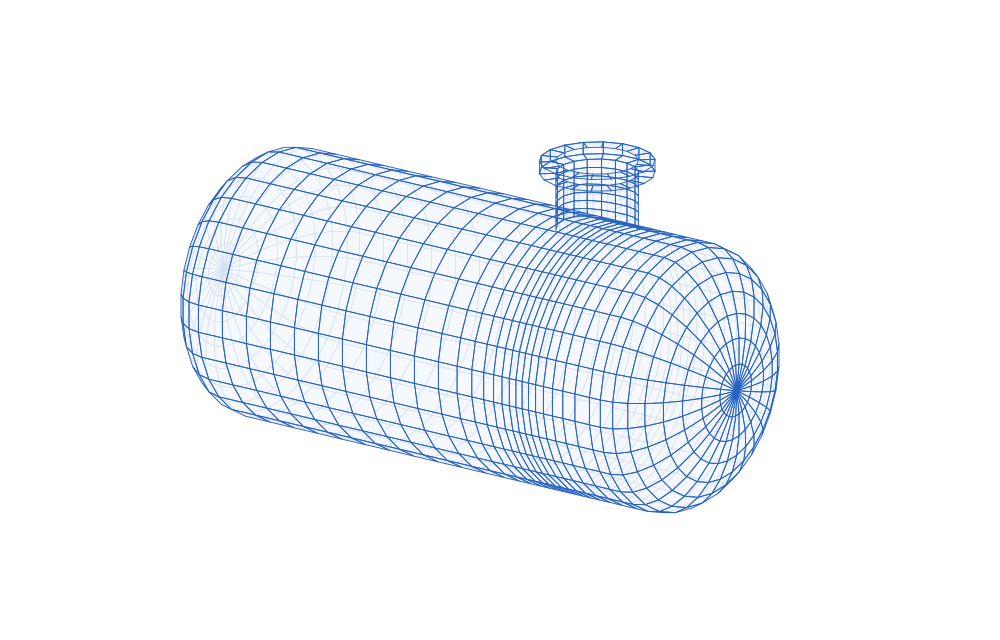
Shell and head stress, nozzle reinforcement, saddle and support design, wind and seismic load cases. Reported against the applicable pressure-equipment code so the pack can go straight to a certifying authority.
Offshore and subsea components
Connectors, clamps, lift points, mooring hardware and turret components. Extreme-load and fatigue cases assessed against offshore design practice, drawing on two decades of North Sea and FPSO project work.
Structural assemblies and equipment frames
Skids, platforms, lifting beams, machine frames and bag-filter casings — where a hand calculation is either impossible or too conservative to be useful.
Failure investigation
Working back from a fracture surface, a deformed part or a service failure to the load case that caused it, and then to a design change that prevents a repeat.
What you receive
A calculation report written to be read by an engineer who was not in the room: stated assumptions, material data with its source, boundary conditions with the reasoning behind them, mesh convergence evidence, and results assessed against the code clause rather than against a generic allowable.
Where the result is marginal we say so plainly, and where the model has a limitation we name it. A report that hides its assumptions is worth very little when it reaches third-party review.
Deliverable contents
A standard FEA package includes:
- Executive summary with the pass/fail conclusion stated first
- Model description, mesh and convergence evidence
- Material properties and their source
- Load cases and boundary conditions with justification
- Stress, deflection and utilisation results
- Code assessment against the relevant clause
- Recommendations where a change is needed
Related services
FEA rarely arrives alone.
Have something that needs analysing?
Send the drawing and the load case. We will tell you what the study needs to cover and what it will cost, usually within a working day.