
Home / Engineering Services / Explicit dynamics
Explicit dynamics
Events measured in milliseconds — impact, drop, blast, penetration — where material behaves in ways a static analysis was never built to describe.
Explicit dynamics has been a core capability since our technical director delivered over 400 hours of industrial training in the discipline in the United Kingdom.
When implicit analysis stops working
Standard structural analysis assumes loads are applied slowly, deflections stay modest and material stays broadly in the elastic range. Impact violates all three at once.
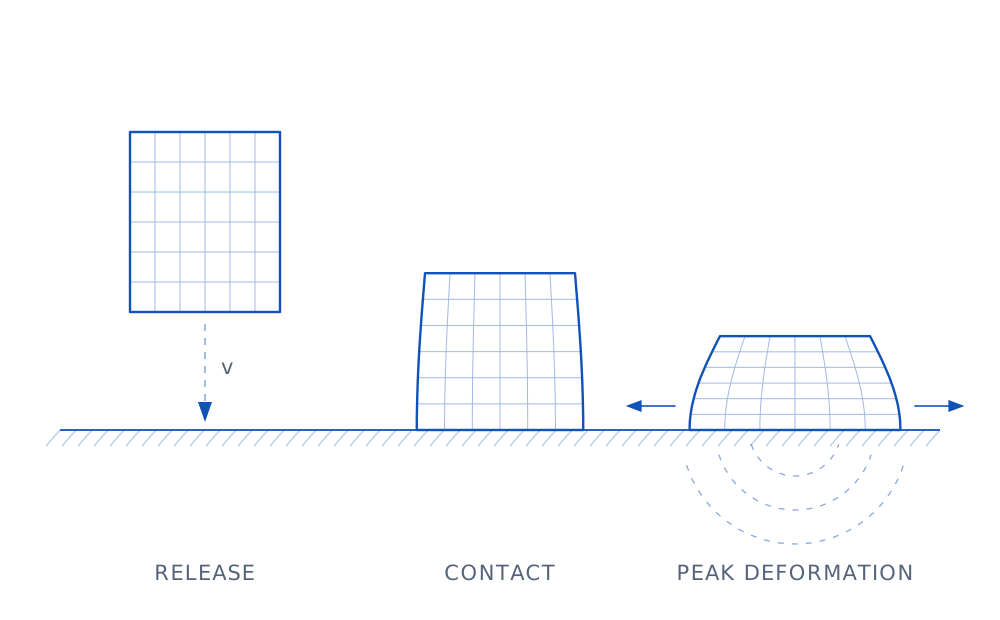
In a drop or a blast, strain rates are high enough to change material properties, deformation is large enough to invalidate the original geometry, and contact between parts is being made and broken continuously. Explicit solvers handle this by stepping through the event in extremely small time increments rather than solving for equilibrium.
The practical consequence: these studies are computationally expensive and unusually sensitive to material data. We are explicit about which material model we used and where the data came from, because that choice drives the answer more than the mesh does.
Typical applications
Drop and impact assessment
Transport containers, dropped-object protection, equipment survivability and packaging — including the dropped-object cases required on offshore installations.
Blast and overpressure
Structural response to blast loading, barrier and enclosure design, and assessment of existing structures against a revised overpressure case.
Penetration and perforation
Projectile and fragment impact on plate, vessel and barrier structures.
Crushing and energy absorption
Deliberate deformation — crush structures, energy absorbers and collapse behaviour where the objective is controlled failure rather than survival.
What limits accuracy
Explicit results are trusted more readily than they should be, because the animations look convincing. Three things dominate the accuracy of the answer, and we report all three:
- Material model and data. Strain-rate-dependent behaviour, failure criteria and their source. Published data for a nominally equivalent grade is not the same as tested data for your material.
- Contact definition. How parts interact, including friction assumptions that are frequently estimated rather than measured.
- Mesh and time step. Resolution in the deformation zone, and the element formulation used.
Have an impact or blast case?
Send the geometry, the event and the material. We will tell you what data the study will need.